

Recommendations are based on practical value and suitability for travelers.
Latest Airport Information — August 2026 Update
Last checked: August 1, 2026
At Narita Airport, SAGAWA Baggage Delivery & Storage is available at Terminals 1 and 2 for standard delivery and temporary baggage storage. Same-day delivery to participating hotels in 10 Tokyo wards and Urayasu is available when baggage is accepted by 2:00 p.m. Operating hours are 6:30 a.m. until one hour after the final arriving flight.
At Haneda Airport Terminal 2, Gong cha opened on July 10, 2026, on the 3rd floor near the connecting bridge to P3 parking. It is open from 9:00 a.m. to 8:30 p.m. and sells drinks and cakes.
THE CAMPANELLA TOKYO has announced a Haneda Airport limited package available at Terminals 1 and 2. Check current product details before buying.
When you search for flights to Tokyo, you will usually see two airport codes:
- HND for Haneda Airport
- NRT for Narita Airport
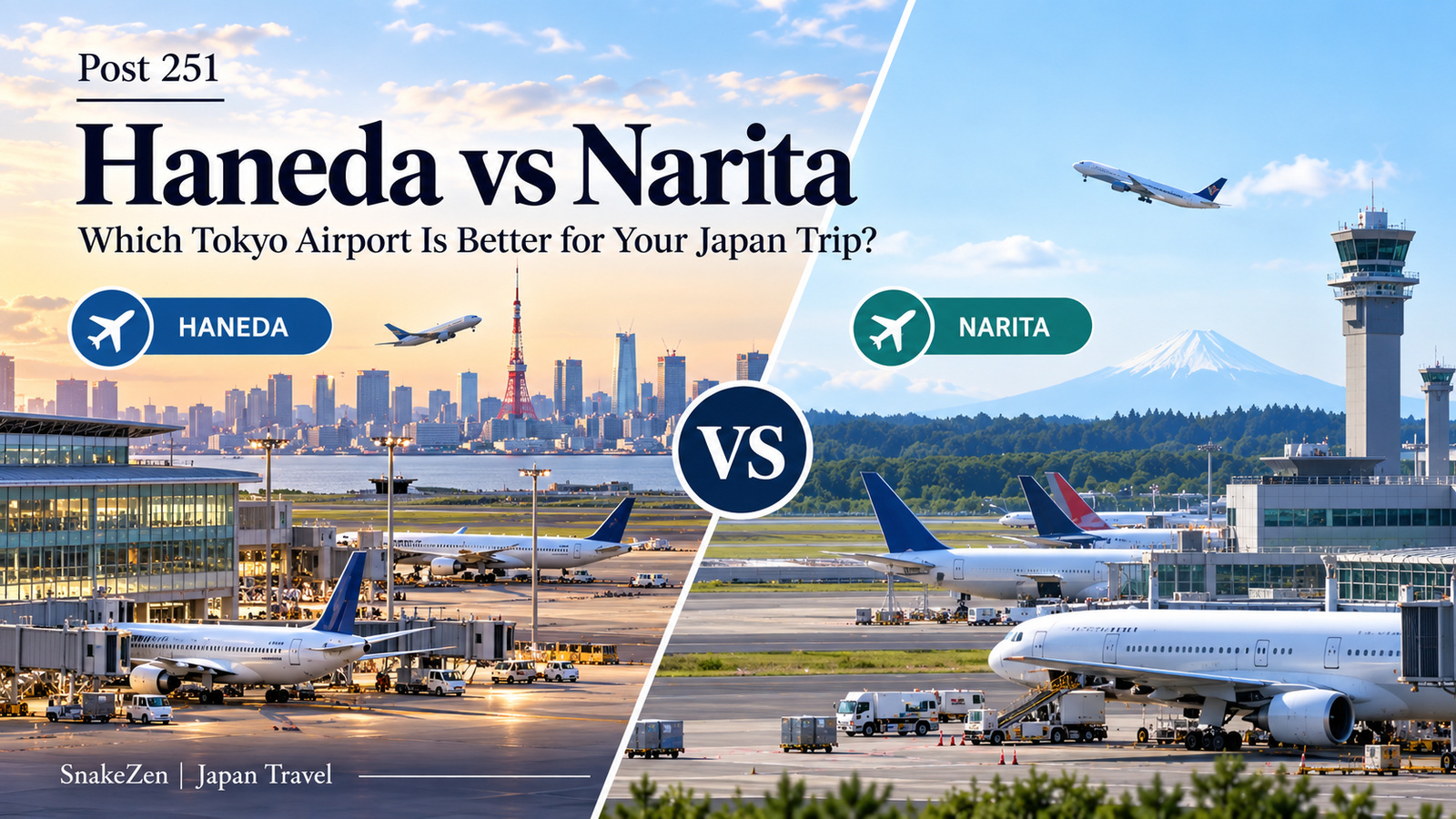
Both airports are reliable international gateways to Japan, but they are not equally convenient for every trip.
For most first-time visitors staying in central Tokyo, Haneda is usually the easier choice.
However, Narita can still be the better option when the flight schedule, ticket price, airline, or your hotel location works more naturally with it.
The best airport is not simply the one closest to Tokyo. It is the one that makes your entire journey easier.
Where are Narita and Haneda?
Haneda Airport is in Ota City within Tokyo, close to central and southern Tokyo. Narita Airport is in Chiba Prefecture, east of Tokyo, so the transfer is usually longer.
Official rail information gives a useful sense of the difference: the fastest Tokyo Monorail service connects Haneda Airport Terminal 3 with Hamamatsucho in 13 minutes, while Keikyu lists Shinagawa at about 14 minutes on its airport access guide. From Narita, the Narita Express can reach Tokyo Station in as little as 53 minutes, and the Skyliner can reach Nippori from Airport Terminal 2・3 in as little as 36 minutes.
A simple way to picture the difference
Haneda usually feels like arriving in Tokyo. Narita feels more like arriving outside Tokyo and then beginning a second journey into the city.
That does not make Narita a poor choice. It means you should compare the complete route from the correct airport terminal to your hotel, including the final transfer and any walking with luggage.
My quick recommendation
Choose Haneda when:
- Your hotel is in central or southern Tokyo
- You want a shorter airport transfer
- You are arriving late or leaving early
- You are traveling with children or heavy luggage
- The flight price is similar to Narita
Choose Narita when:
- The flight is significantly cheaper
- Your preferred airline or nonstop route uses Narita
- You are staying near Ueno, Nippori, Asakusa, or eastern Tokyo
- You are comfortable allowing more time for the airport transfer
- Your itinerary connects well with the Narita Express or Keisei Skyliner
This article contains affiliate links. I may receive a commission if you book or purchase through them.
Why Haneda is usually easier
Haneda Airport is directly connected to both the Keikyu Line and Tokyo Monorail. The Tokyo Monorail’s fastest service takes about 13 minutes from Terminal 3 to Hamamatsucho, where travelers can transfer to JR lines.
This makes Haneda especially convenient for areas such as:
- Shinagawa
- Hamamatsucho
- Tokyo Station
- Shibuya
- Shinjuku
- Yokohama
The exact journey depends on your train and transfer, but the airport is generally much closer to central Tokyo than Narita.
That shorter distance matters more than many visitors expect.
After a long international flight, one less transfer and a shorter train journey can make your arrival feel much calmer.
When Haneda is the better choice
You are staying in central Tokyo
Haneda is often the simplest choice for hotels around Tokyo Station, Shinagawa, Shibuya, Shinjuku, Ginza, Roppongi, and the Tokyo Bay area.
The airport’s rail connections make it easy to reach major transport hubs without beginning your trip with a long cross-region journey.
You are arriving late
A late arrival can make any airport transfer stressful.
Immigration, baggage collection, and customs may take longer than expected. If your flight arrives in the evening, Haneda’s shorter distance from central Tokyo usually gives you more flexibility.
Always check the final train and bus times for your arrival date. Do not assume that public transportation operates throughout the night.
You have children or large luggage
The difference between a simple journey and a difficult one is often the number of transfers.
With suitcases, a stroller, or tired children, even one additional station change can feel demanding.
Haneda will not always provide a direct journey to your hotel, but it often reduces the total distance and number of complicated transfers.
You have a domestic flight connection
Haneda is a major hub for domestic flights in Japan. Travelers continuing to another Japanese city may find it more convenient when both flights use the same airport.
Still, check the terminal and connection time carefully. Haneda has three passenger terminals, and passengers can move between them using the free shuttle bus, Keikyu Line, Tokyo Monorail, and the underground passage between Terminals 1 and 2.
Why Narita can still be a good choice
Narita Airport is farther from central Tokyo, but its rail connections are designed to handle international travelers.
The Narita Express directly connects the airport with major areas including Tokyo, Shinagawa, Shibuya, Shinjuku, and Yokohama. The fastest trip from Narita Airport Station to Tokyo Station is listed at 53 minutes.
The Keisei Skyliner connects Narita Airport with Nippori and Ueno. The fastest journey between Airport Terminal 2・3 Station and Nippori is about 36 minutes.
Narita is therefore not necessarily difficult.
It simply requires more planning.
When Narita may be the better choice
Your flight is much cheaper
A modest saving may disappear after you include airport transport, extra travel time, and the inconvenience of a late arrival.
But when the fare difference is large, Narita may still offer the better overall value.
Compare the complete journey, not only the airfare.
Consider:
- Airport transportation
- Luggage costs
- Arrival time
- Hotel check-in time
- The number of transfers
- The value of your time
You are staying near Ueno or Nippori
The Keisei Skyliner is particularly useful for travelers staying near Ueno or Nippori.
Nippori provides connections to JR lines, while Ueno is convenient for parts of northern and eastern Tokyo.
Narita may therefore feel more convenient than expected when your first hotel is in this part of the city.
Your airline or nonstop route uses Narita
A nonstop flight is often more valuable than choosing Haneda with an inconvenient connection.
Changing aircraft adds risks:
- Missed connections
- Delayed baggage
- Longer travel time
- Additional airport procedures
- More physical strain
A comfortable nonstop flight to Narita may be better than a tiring multi-stop journey to Haneda.
You plan your airport transfer in advance
Narita becomes easier when you know your route before landing.
The airport is served by JR, the Narita Sky Access line, and the Keisei line, with train ticket counters available inside the airport.
Before flying, decide:
- Which train or bus you intend to use
- Where you will transfer
- How you will reach your hotel from the final station
- What you will do if your flight is delayed
Saving screenshots of the route can be very helpful.
Narita Express or Skyliner?
The answer depends mainly on your destination.
Choose the Narita Express when:
- You are going to Tokyo Station
- You are staying near Shinagawa
- You are heading toward Shibuya or Shinjuku
- You are traveling to Yokohama
- You prefer a direct JR journey to a major station
The Narita Express serves several major destinations directly, reducing the need to move luggage between trains.
Choose the Skyliner when:
- You are staying near Ueno
- You are staying near Nippori
- You want a fast connection to the JR network at Nippori
- Your hotel is in northern or eastern Tokyo
The Skyliner runs between Narita Airport, Nippori, and Keisei Ueno, and is designed as a fast airport service.
Neither train is universally better.
Choose the one that reduces transfers after you reach Tokyo.
Official fare snapshot checked in July 2026
JR East lists the N’EX TOKYO Round Trip Ticket at ¥5,200 for adults and ¥2,600 for children, valid for 14 days. Keisei lists the standard Skyliner one-way fare between Narita Airport and Nippori or Keisei Ueno at ¥2,580 for adults and ¥1,290 for children; its official online discount is ¥2,310 and ¥1,150 respectively.
For Haneda, Tokyo Monorail lists the printed one-way fare between Monorail Hamamatsucho and the airport terminals at ¥520 for adults and ¥260 for children. Keikyu lists a printed one-way fare of ¥330 between Shinagawa and Haneda Airport Terminal 3.
Ticket conditions differ, and the lowest price is not always the simplest route. Check the official fare and timetable again for your date, terminal, and destination.
Do not forget your arrival terminal
Before planning your route, check the terminal shown on your airline booking.
At Narita:
- Terminal 1 uses Narita Airport Station
- Terminals 2 and 3 use Airport Terminal 2・3 Station
- Terminal 3 requires an additional walk from the railway station
Narita Airport states that Terminal 1 is about a five-minute walk from its station, Terminal 2 about five minutes, and Terminal 3 about ten minutes from Airport Terminal 2・3 Station.
At Haneda, international flights commonly use Terminal 3, but some international services also use Terminal 2. Always confirm your airline and terminal shortly before travel.
What about airport buses?
Airport buses can be useful when they stop directly at or near your hotel.
They may be especially comfortable when:
- You have several suitcases
- You want to avoid train transfers
- Your hotel is served directly
- You are traveling with children
- Stairs and crowded stations would be difficult
However, buses are affected by road traffic. Allow extra time, especially when traveling back to the airport.
Narita also has lower-cost bus services connecting the airport with central Tokyo.
Arriving early in the morning or late at night?
Do not assume trains and buses run all night. Check your scheduled landing time, allow for immigration and baggage collection, and then compare the last practical connection with a backup plan.
Haneda’s official bus page lists late-night and early-morning access buses, including services after midnight from Terminal 3, but it also warns that schedules may change with flight operations. At Narita, some terminal areas and a limited number of convenience stores, restaurants, and rest facilities operate 24 hours, while other floors and services close overnight.
If the final train or bus is too tight, consider an airport or terminal hotel, a paid rest facility, or a later transfer after services restart. Confirm the current operating hours and availability before travel.
Food after a late arrival
Restaurant choice becomes much smaller late at night. Narita’s official overnight guide currently lists a 24-hour restaurant in Terminal 2, another in Terminal 3, and 24-hour convenience stores in each terminal. Haneda’s official restaurant directory can be filtered for 24-hour or late-night opening, but individual store hours may change.
Before relying on a particular place, check the airport’s official restaurant page for your terminal, whether the shop is before or after security, and the latest hours.
Special dietary needs and traveling with a baby
Vegetarian, vegan, halal-certified, halal-friendly, allergy information, baby food, and child-friendly meals are different categories. Do not treat one label as proof of another.
Narita and Haneda provide official restaurant search filters for some dietary preferences and children’s menus, but a filter does not by itself confirm certification, ingredients, shared kitchens or equipment, allergy safety, baby-food age suitability, stock, outside-food rules, or heating support. Ask the airport or the individual restaurant directly when any of these points matters to your trip.
Where can you rest?
Official options include showers, nap or refresh rooms, lounges, capsule hotels, and terminal hotels, depending on the airport and terminal. Public seating is not the same as a guaranteed sleeping space, and access rules can differ before and after security.
At Narita, official shower rooms cost ¥1,500 for the first 30 minutes and ¥750 for each additional 15 minutes. Nap rooms cost ¥3,000 for the first 60 minutes for a single room or ¥5,000 for a twin room, with additional-time charges shown on the airport’s official page.
At Haneda Terminal 3, the official 24-hour shower room charges ¥1,500 for 30 minutes, then ¥750 for each additional 15 minutes. A refresh room costs ¥3,000 for 60 minutes, then ¥1,500 for each additional 30 minutes. The Terminal 3 SKY LOUNGE is also open 24 hours and lists tax-included fees of ¥1,500 for adults, ¥750 for children aged 4–12, and no charge for ages 0–3, with a maximum stay of three hours.
Luggage storage can change the practical choice
Both airports list paid coin lockers. Narita’s daily-charge lockers start at ¥400 per day for a small locker, while Haneda Terminal 3 lists small lockers at ¥500 per 24 hours. Locker size, location, charging method, and maximum storage period differ, so check the official terminal page before relying on one.
Airport food and souvenirs can also affect your choice
Both airports have official restaurant and shop directories covering Japanese food, cafes, convenience stores, duty-free shopping, and souvenirs. The useful comparison is not simply which airport has more shops, but which options are open in your terminal and available before or after security at the time you will be there.
No specific meal or souvenir price is included here because menus, stock, and operating hours can change. Check the official store page for current details.
Nearby places worth considering
If you choose Narita, the airport area and Narita City can be practical for an overnight stay before an early departure or after a late arrival. If you choose Haneda, southern Tokyo and Yokohama may fit naturally into your first or final day.
Base that decision on your flight time, hotel check-in or check-out, luggage, and the route you plan to use rather than on the airport name alone.
Read the detailed guides
The following planned guides will cover these topics in more detail. They are shown as plain text because the articles have not yet been published.
- Narita Airport: Restaurants and Souvenirs Worth Trying
- Haneda Airport: Restaurants and Souvenirs Worth Trying
- Narita Airport: Where to Rest, Shower, or Stay Overnight
- Haneda Airport: Where to Rest, Shower, or Stay Overnight
- Narita and Haneda: Halal, Vegetarian, Allergy, and Baby Food Guide
A simple decision guide
Choose Haneda when convenience matters most
Haneda is usually worth choosing when the fares are similar and your trip begins in central Tokyo.
The shorter transfer can save energy on your arrival day and reduce the risk of problems before an early departure.
Choose Narita when the flight itself is better
Narita remains a sensible choice when it offers:
- A much better fare
- A nonstop flight
- A more convenient departure time
- Your preferred airline
- Easy access to Ueno, Nippori, or eastern Tokyo
Do not reject Narita automatically.
A well-planned Narita arrival can be comfortable and straightforward.
My honest conclusion
For most first-time visitors, I would choose Haneda when the flight price and schedule are reasonably similar.
It is closer to central Tokyo, easier after a long flight, and more forgiving when you have luggage or arrive later in the day.
But I would choose Narita without hesitation when it offers a significantly better nonstop flight or works naturally with a hotel near Ueno, Nippori, or eastern Tokyo.
The airport code is only one part of the decision.
Look at the complete journey from your home to your hotel room.
The best choice is the one that allows you to begin Japan feeling curious and excited—not tired before the trip has truly started.
Access routes, journey times, terminal operations, and transport schedules can change. Check your airline, airport terminal, and the official railway or airport website shortly before travel.
Related Japan Travel Guides
Once you have chosen your airport, prepare your mobile connection and check the best way to reach central Tokyo.